Managing money can feel complicated when bills, personal spending, and future goals compete. The 50/30/20 budget rule offers a simple framework for people who want more clarity without tracking every small purchase.
What Is the 50/30/20 Budget Rule?
The rule divides your after-tax income into three broad categories: needs, wants, and financial goals. Each category receives a target percentage, creating a basic structure for everyday money decisions.
Under the standard model, 50% covers essential expenses, 30% supports discretionary spending, and 20% goes toward savings and extra debt repayment. These percentages are guidelines rather than financial requirements.
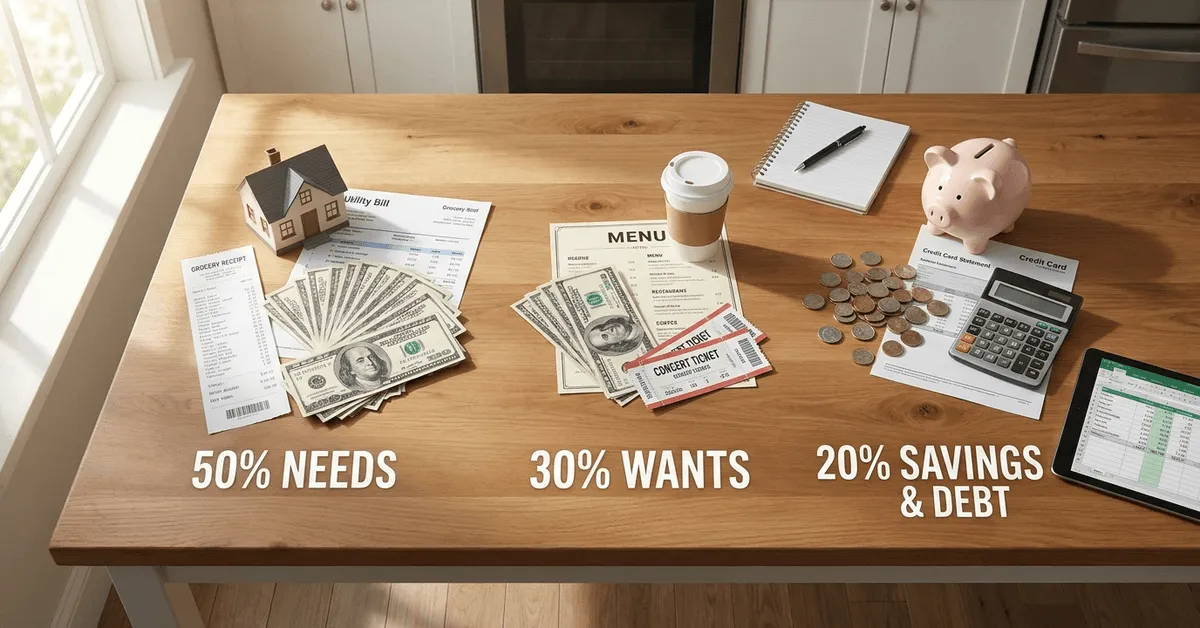
The main benefit is perspective rather than precision. A household can see whether fixed costs leave enough space for enjoyment and future security, without creating dozens of separate spending categories.
| Budget category | Target share | Typical examples |
|---|---|---|
| Needs | 50% | Housing, basic groceries, utilities, essential transport, minimum debt payments |
| Wants | 30% | Dining out, entertainment, holidays, optional subscriptions |
| Savings and extra debt repayment | 20% | Emergency savings, retirement contributions, additional loan payments |
How to Calculate Your After-Tax Income
A useful starting point is after-tax income : the money available after income taxes and mandatory deductions. Gross salary usually overstates what a household can actually allocate to monthly expenses.
For employees, a payslip can reveal deductions that never reach a bank account. Workplace retirement contributions deserve special attention because they may already represent part of the savings allocation.
One consistent method adds voluntary payroll retirement contributions back to take-home pay, then records them in the 20% category. This prevents those contributions from disappearing from the budget calculation.
Self-employed workers face a different calculation. Business expenses and a reasonable tax reserve come before personal budgeting, because customer payments are not the same as money available for household spending.
What Belongs in the 50% Needs Category?
Essential expenses are costs that support basic living and necessary obligations. They commonly include housing, basic utilities, groceries, required insurance, essential transport, and minimum debt payments.
The distinction depends partly on circumstances. Internet access may be essential for remote work, while a premium connection chosen mainly for entertainment may contain an optional portion rather than a pure need.
Childcare, disability-related costs, and necessary medical treatment can also belong here. A realistic budget reflects the household's actual situation, not an idealized picture of what another person considers essential.
Why Housing Often Determines the Outcome
Housing is frequently the largest fixed expense, which makes it especially influential. When rent or mortgage payments absorb much of take-home income, the standard percentages may be difficult to achieve.
That mismatch does not automatically indicate careless spending. Local housing shortages, family responsibilities, and limited transport options can leave households with fewer affordable choices than a formula assumes.
What Belongs in the 30% Wants Category?
Discretionary spending covers purchases that improve comfort or enjoyment without being necessary for basic functioning. Restaurant meals, streaming services, leisure travel, and hobby upgrades often fit here.
Some expenses contain both a need and a want. Basic groceries are essential, for example, but premium convenience products may include an optional element. A practical split can be more useful than a rigid label.
The 30% allocation is a ceiling within the standard framework, not an amount that must be spent. Someone who enjoys inexpensive activities may use less and direct the difference toward another financial priority.
How the 20% Savings and Debt Category Works
The final portion supports financial resilience and longer-term progress. Emergency
savings, retirement contributions, and payments above required debt minimums are common uses for this part of the budget.
Minimum debt payments usually remain in needs because they are contractual obligations. Additional repayments belong in the financial goals category, which keeps the same payment from being counted twice.
Not every transfer into a savings account represents long-term saving. Money reserved for an upcoming holiday still funds a want, while money for an annual insurance bill usually funds a future essential expense.
Emergency Savings and Expensive Debt
An emergency fund provides accessible money for unexpected essential costs. The appropriate amount depends on income stability, dependents, insurance coverage, and the support available within a household.
High-interest debt can compete with emergency savings for limited money. A small cash buffer may reduce reliance on new borrowing, while additional repayments can reduce interest costs on existing balances.
There is no universal sequence that fits every household. Interest rates, repayment penalties, employer retirement benefits, and immediate cash needs can all affect the balance between saving and paying down debt.
A 50/30/20 Budget Example Using Monthly Income
Consider a household with monthly after-tax income of 3,000 currency units. The standard split allocates 1,500 to needs, 900 to wants, and 600 to savings and additional debt repayment across its monthly budget.
The calculation works with euros, dollars, pounds, rupees, or another currency because the method relies on percentages. Purchasing power and local living costs, however, determine whether those targets are realistic.
| Category | Calculation | Monthly allocation |
|---|---|---|
| Needs | 3,000 × 0.50 | 1,500 |
| Wants | 3,000 × 0.30 | 900 |
| Savings and extra debt repayment | 3,000 × 0.20 | 600 |
Within the 600 financial goals allocation, the household might place 250 in emergency savings, contribute 200 toward retirement, and pay 150 above its required debt minimums. This is an illustration, not a prescription.
How to Build a Monthly Budget Around the Rule
A working budget connects percentage targets with actual transactions. Recent bank statements, card statements, and cash records provide a clearer picture than estimates based only on memorable purchases.
Several months of records can reveal expenses that a single month misses. Seasonal utility bills, school costs, annual renewals, and irregular transport expenses often explain why an apparently balanced budget falls short.
- Income baseline: Reliable monthly after-tax income establishes the amount available for allocation.
- Expense classification: Existing spending is grouped into needs, wants, and financial goals.
- Percentage comparison: Each category total is divided by income and multiplied by 100.
- Gap analysis: Differences between actual spending and target shares reveal the main pressure points.
- Ongoing review: Later results show whether the allocations match real household conditions.
The first calculation is a snapshot, not a verdict. A household spending 62% on needs has identified a constraint, not failed a test. That information makes later decisions more grounded and less dependent on guesswork.
Using the Rule With Irregular or Freelance Income
Variable income makes a fixed monthly plan harder to maintain. Freelancers, seasonal workers, and commission earners may receive enough over a year while still facing difficult gaps between individual payments.
A conservative income baseline can make those gaps more visible. This might reflect a typical lower-earning month rather than a recent peak, although the most useful measure depends on the pattern of work and payments.
Money held for predictable low-income periods serves a different purpose from emergency savings. It supports ordinary cash flow, while an emergency fund covers unexpected events beyond the normal earning cycle.
When Essential Expenses Exceed 50% of Income
The standard split becomes less useful when necessities already consume most available income. High housing costs, low wages, medical expenses, or caregiving responsibilities can make a 50% needs target unrealistic.
An adjusted split, such as 60/20/20 or 70/20/10, may describe current conditions more honestly. These alternatives preserve the three-category structure without pretending that every household has identical financial flexibility.
A lower savings percentage can still represent meaningful progress. The important distinction is between a temporary adaptation and an unnoticed pattern that leaves recurring bills dependent on borrowing or unpaid balances.
What the Rule Cannot Fix
A budgeting framework cannot make inadequate income cover unlimited necessities. When essential costs exceed earnings, the problem goes beyond category labels and may involve access to support, income, or affordable services.
Likewise, reducing small optional purchases may have little effect on a large structural deficit. Minor savings can help, but they do not carry the same financial weight as housing, childcare, or ongoing medical costs.
Tracking Spending Without Making Budgeting a Second Job
A spreadsheet, budgeting application, or simple notebook can all support this method. The useful feature is consistent categorization rather than elaborate software, especially when only three main totals are needed.
Transfers between personal accounts are not new income or fresh spending by themselves. Recording both the transfer and the eventual purchase as expenses can inflate totals and make the budget appear less accurate.
Credit card purchases also require consistent treatment. When purchases are recorded as spending, paying the corresponding card balance is not a second expense. Interest and fees, however, remain separate costs.
Adjusting the Budget for Different Life Stages
A person entering the workforce may face moving costs, deposits, and a small emergency fund. A family with young children may have substantial childcare expenses. The same percentage targets can feel very different.
Retirees may fund living costs through pensions, benefits, or planned withdrawals rather than wages. For them, the framework needs adaptation because saving 20% may not match the purpose of their retirement income plan.
Shared finances add another layer. Couples may budget from combined income or maintain separate plans alongside shared bills, but clear treatment of joint expenses helps prevent omissions and duplicated allocations.
Common 50/30/20 Budgeting Mistakes
Treating the Percentages as a Scorecard
A neat ratio can look reassuring even when important expenses are missing. A useful budget accounts for reality first; matching the percentages matters less than paying obligations and understanding where the money goes.
Forgetting Predictable but Infrequent Costs
Vehicle maintenance, annual fees, and replacement appliances do not always appear each month. Setting aside a monthly share recognizes their eventual
cost and reduces the chance of mistaking reserved money for spare cash.
Confusing Investment Returns With Guaranteed Progress
Investment contributions can support long-term goals, but investment values can fall. Money needed soon has different requirements from retirement money, and a percentage-based budget does not remove investment risk.
Frequently Asked Questions About the 50/30/20 Budget Rule
Is the Rule Based on Gross Income or Take-Home Pay?
The usual starting point is after-tax income rather than gross salary. Payroll deductions may need separate treatment, especially retirement saving, so the income figure and category totals follow a consistent method.
Can the Rule Work for Someone With Debt?
Yes, although repayment obligations may require a modified split. Required minimum payments usually count as needs, while additional repayments sit within the financial goals category alongside savings contributions.
Does Saving 20% Guarantee Financial Security?
No fixed savings rate guarantees a particular outcome. Starting age, existing assets, investment results, inflation, and future expenses all matter. The rule provides a budgeting structure, not a financial forecast.
Is a Paid Budgeting App Necessary?
No subscription is required to use the method. Basic arithmetic and reliable spending records are enough to calculate the three categories, while paid tools mainly add convenience, automation, or reporting features.
A Flexible Budget Can Turn Income Into Lasting Progress
The 50/30/20 budget rule is most useful as a clear view of competing priorities. It connects everyday spending with future goals while leaving room for enjoyment, changing circumstances, and imperfect months.
Its real strength is not a perfect ratio. It is the ability to see whether current spending
supports the life a household is trying to build, and whether the gap between present needs and future plans is narrowing.
For readers ready to apply the framework, the CFPB's official consumer tools offer further financial education. No application is required; the rule is a budgeting method, not a financial product.