Free books and educational materials can make learning more affordable.
For students, parents, teachers, and independent learners worldwide,
the real benefit is knowing which sources are useful, legal, and genuinely free.
What Free Educational Resources Actually Include
Free learning resources extend well beyond downloadable novels.
They include school textbooks, university course notes, worksheets,
audiobooks, research papers, and accessible reading formats for eligible users.
However, free access does not always mean unrestricted use.
A book might cost nothing to read online while its license limits copying,
translation, classroom redistribution, or the creation of an adapted version.
Three common categories are public domain books , openly licensed works,
and materials available through a library or institutional subscription.
Each category has different access conditions and permissions.
The distinction matters when materials will be shared with others.
Reading a chapter privately is different from uploading an entire textbook
to a public website, even when the original download was available without charge.
Public Libraries Offer More Than Printed Books
Local Membership and Borrowing
Public libraries are often the most practical starting point.
Depending on local funding and membership rules, their collections may include
printed books, digital magazines, language courses, and educational databases.
Library membership is commonly free for eligible local residents,
although identification, proof of address, or a parent’s permission may apply.
Nonresident access and replacement cards can carry separate charges.
Digital Collections and Shared Catalogs
Many libraries provide free ebooks and audiobooks through licensed services.
Access usually requires a valid library card, and available titles depend
on the collection purchased by that particular library system.
Popular digital titles may have waiting lists, just like printed books.
Interlibrary loan can expand access to physical collections, although delivery
times, eligible materials, and possible charges vary between library networks.
Public Domain Books Make Classic Reading More Accessible
Public domain collections are especially useful for older literature,
historical documents, and foundational writing in philosophy or science.
They can support reading practice without a recurring subscription.
Project Gutenberg’s official free ebook library offers many older works
in formats suitable for browsers and reading devices. Its collection is
particularly useful for classic literature rather than current commercial textbooks.
Copyright rules differ across countries, which complicates global access.
A work treated as public domain in the United States may still be protected
elsewhere, depending on the author, publication history, and local legislation.
Older books also reflect the knowledge and attitudes of their time.
A historical medical text can be valuable for research without being suitable
as a source of current health advice, scientific guidance, or treatment information.
Open Educational Resources Can Replace Expensive Textbooks
How Open Textbooks Work
Open educational resources , often called OER, are teaching materials
released under licenses that permit specified forms of reuse.
They can include complete textbooks, lesson plans, exercises, and assessment guides.
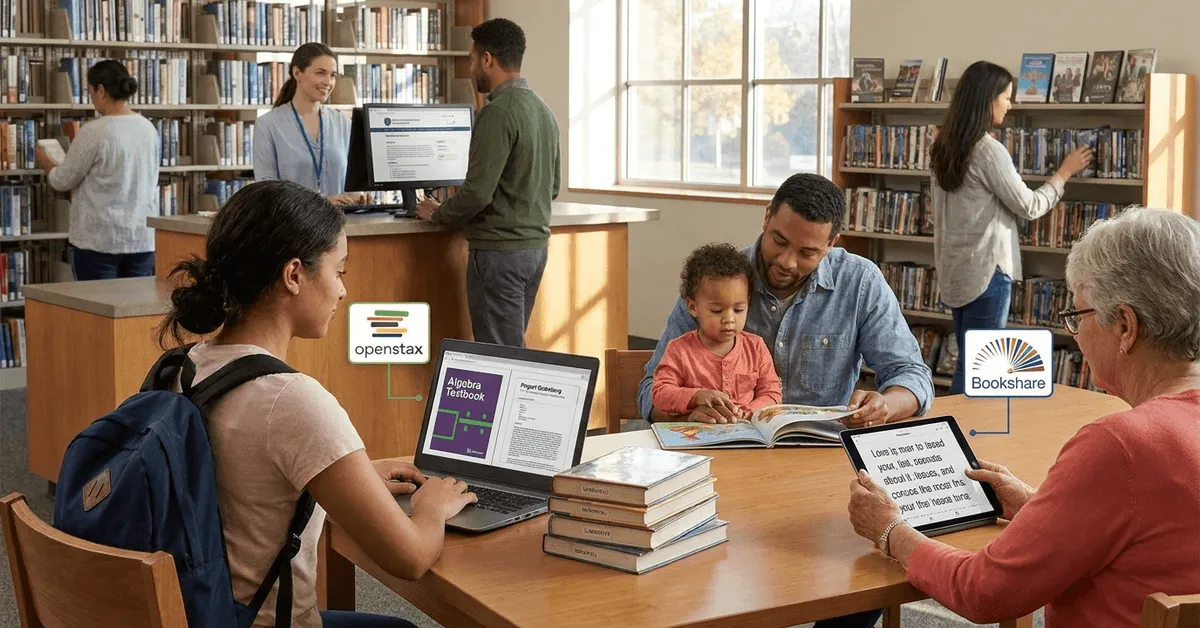
OpenStax is one established source of openly licensed textbooks,
particularly for commonly taught subjects. Other universities and nonprofit
publishers maintain collections covering different disciplines and educational levels.
Licensing and Course Compatibility
Licenses determine whether a resource can be adapted or redistributed.
Some require attribution, while others include additional conditions.
The permissions attached to one textbook do not automatically apply to another.
A free textbook is most useful when it matches the actual course.
Chapter coverage, mathematical notation, local terminology, and edition changes
can affect whether it works as a replacement or only as supplementary reading.
Universities and Research Repositories Provide Academic Materials
University websites sometimes publish lecture notes, reading lists,
recorded classes, and practice assignments for public use.
These materials can support independent study even without formal enrollment.
Access to course content is not the same as admission to a university.
Free materials generally do not include academic credit, personalized feedback,
graded assessments, or the full support available to registered students.
Open access research can provide legal access to scholarly articles.
University repositories and journal websites may host published papers
or permitted manuscript versions, although availability differs by publication.
Research papers are not always ideal introductions to a subject.
They often assume background knowledge and focus on narrow questions.
A textbook or introductory course can provide context before more specialized reading.
Free Learning Materials for Children and Families
Age, Language, and Reading Level
Children benefit from resources that match both interest and ability.
A book’s suggested age range is only a rough guide; vocabulary, sentence length,
illustrations, and familiarity with the topic also influence reading difficulty.
Public education departments, libraries, and established nonprofits
often publish worksheets, stories, and literacy activities at no charge.
Availability in local languages can vary considerably across countries and regions.
Curriculum and Offline Learning
School subjects do not follow identical sequences around the world.
A worksheet labeled for one grade may introduce concepts earlier or later
than a local curriculum, especially in mathematics, grammar, history, and geography.
Printable materials can be helpful where internet access is unreliable.
Still, paper and ink create real costs, so a free download is not necessarily
the cheapest option compared with borrowing a printed book or reading offline.
Accessible Books and Eligibility-Based Programs
Standard ebooks do not meet every reader’s accessibility needs.
Some learners require structured audio, screen-reader-compatible text,
braille-ready files, or adjustable presentation that ordinary scanned pages cannot provide.
Bookshare provides accessible reading materials for people with
qualifying reading barriers. Access depends on its eligibility requirements,
with membership arrangements and available titles varying by location and user category.
A diagnosis alone does not automatically establish eligibility.
The relevant question is whether a person meets the program’s criteria,
and supporting confirmation may be required through its approved membership process.
For readers who may qualify, Bookshare’s official sign-up page provides a route to begin registration and review the applicable requirements.
Membership terms and any charges depend on the applicant’s circumstances.
Local Exchanges Can Provide Free Physical Books
Digital reading is convenient, but physical books still matter.
Community book exchanges, neighborhood sharing shelves, and school reuse schemes
can circulate useful materials without requiring a new purchase from each reader.
Availability is usually unpredictable because collections depend
on local donations. General reading books may be easier to find than a recent
specialist textbook, a particular edition, or a complete set of course materials.
Some schools and colleges coordinate textbook lending or hardship support.
These arrangements are institution-specific, and eligibility may depend
on enrollment, household circumstances, course participation, or available funding.
A donated textbook can still be useful when it is not the newest edition.
However, changes to legislation, software, clinical guidance, and exam syllabuses
can make older versions unsuitable for certain subjects or qualifications.
Safe Downloads and Legitimate Access Matter
Recognizing Common Warning Signs
A site promising every newly released textbook for free deserves caution.
Unauthorized copies may expose readers to copyright problems, misleading ads,
credential theft, or downloads that have little connection to the promised book.
A legitimate reading download normally does not require disabling
security software or installing an unrelated browser extension.
Unexpected executable files are particularly concerning when the advertised item is a book.
Privacy, Payments, and File Formats
Secure HTTPS connections protect data in transit, but they do not prove
that a website is trustworthy. Clear ownership information, transparent terms,
and a credible relationship with the publisher or library provide stronger context.
Some services advertise free trials rather than permanent free access.
Payment-card requirements, automatic renewals, printing charges, and delivery fees
can change the actual cost, even when the headline describes the material as free.
Choosing Materials That Support Real Progress
The largest collection is not always the most useful collection.
A reliable textbook with clear explanations and suitable practice exercises
can support more progress than dozens of unrelated downloads saved for later.
Quality checks include author expertise, publication date, references,
and the organization responsible for the material. These details matter
especially for subjects where outdated information can cause practical harm.
Language and format affect usability as much as subject coverage.
Searchable text, readable diagrams, navigation, and compatibility with a learner’s
device can determine whether an otherwise excellent resource is actually usable.
Offline access is another important difference between platforms.
Some allow permanent downloads, while others provide temporary library loans
or browser-only reading that remains dependent on an active internet connection.
Common Questions About Free Books and Educational Materials
Are Free Books Always Legal?
No. A zero price does not establish permission to distribute a book.
Legal access can come from public domain status, an open license, a publisher’s
authorization, or a library agreement that covers borrowing by eligible members.
Can Free Materials Replace Paid Courses?
Sometimes they can cover much of the same subject knowledge.
However, materials alone may not replace instruction, supervised practice,
recognized assessments, professional accreditation, or a credential required by an employer.
Are Free Certificates Included?
Not necessarily. A platform may provide learning content without charge
while requiring payment for a certificate, identity verification, or an exam.
Free access to lessons and free certification are separate benefits with separate terms.
Why Is the Same Book Available in One Country but Not Another?
Copyright terms, distribution rights, library contracts, and program funding
can all affect access. A resource available to readers in one country
may be restricted elsewhere without the restriction indicating a technical fault.
Free Learning Works Best When Access and Quality Come Together
Free books and educational materials can remove a meaningful cost barrier.
Libraries, open textbooks, public domain collections, and accessible reading
programs each serve different needs rather than offering one universal solution.
The strongest options combine lawful access with relevant content,
usable formats, and clear conditions. A resource earns its place through
how well it supports learning, not through the size of its collection or download count.
Education does not become valuable only when it carries a price tag.
Reliable free resources can support schoolwork, professional development,
family reading, and personal curiosity while leaving more room in a limited budget.