Learning how to open a bank account online can make everyday money management easier. The process often takes place on a website or app, although approval is not always immediate.
This guide is for first-time applicants, people comparing banks, and anyone moving abroad. It explains the documents, costs, and security checks that matter before an application begins.
How Online Bank Account Opening Works
An online application usually combines personal details, identity verification, and acceptance of account terms. Some banks complete everything remotely; others require an additional visit.
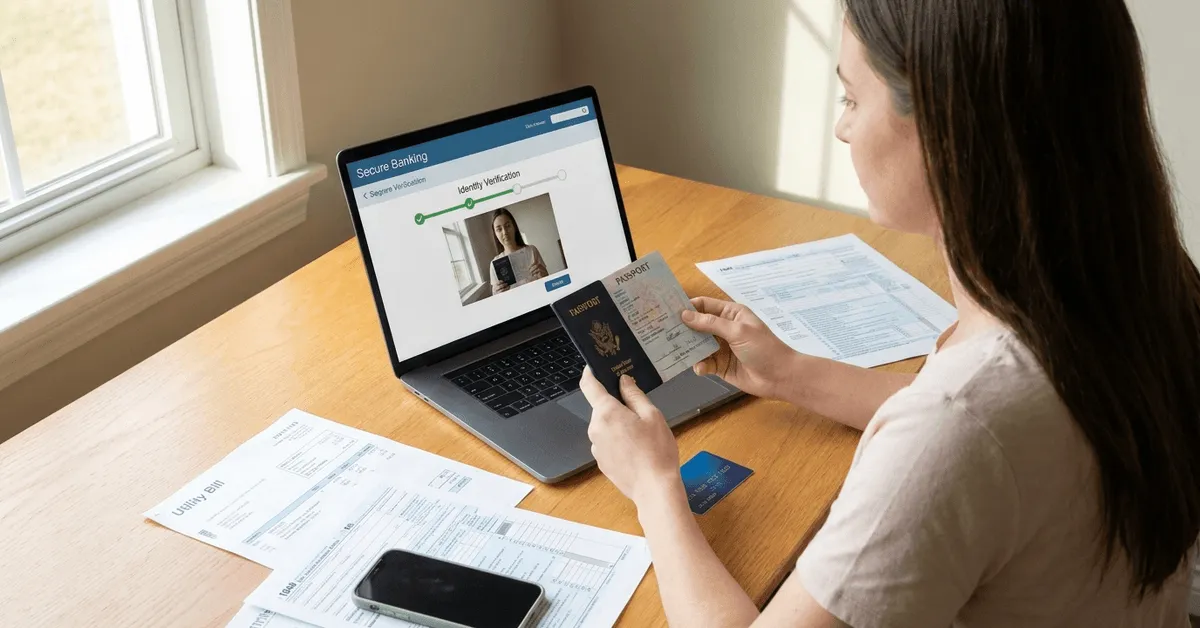
The available options depend on your country, residency, age, and the provider’s rules. A bank that accepts local residents may not accept applicants living overseas, even with valid identification.
There is also an important distinction between submitting an application and opening an account. Access to payments, transfers, or a debit card may depend on further checks or an initial deposit.
What You May Need to Open a Bank Account Online
Requirements vary, but most providers request enough information to establish who you are and where you live. Having current documents available can reduce delays and repeated verification requests.
- Identity document: A valid passport, national identity card, or another accepted government-issued document.
- Address details: Your residential address and, where required, an accepted proof-of-address document.
- Tax information: Your tax residence and relevant tax identification numbers.
- Contact information: An accessible email address and a supported mobile number.
- Funding details: An eligible payment method if an opening deposit is required.
Some institutions also ask about employment, income, the purpose of the account, or the source of your money. These questions commonly support legal compliance rather than a promise of credit approval.
Document rules can be surprisingly specific. A bank might accept a recent utility bill but reject a screenshot, an expired document, or correspondence showing a different version of your address.
Minimum age rules also differ between countries and account types. Children’s and teenage accounts may require a parent or guardian, with separate identity checks for the adults involved.
Choosing the Right Online Bank Account
The best account is usually the one that suits your actual transactions, not the one with the longest feature list. Salary payments, cash access, and international transfers deserve different priorities.
A traditional bank, a digital bank, and a payment app may offer similar-looking interfaces while operating under different legal arrangements. That distinction matters when you consider protection.
| Account type | Typical purpose | Important comparison point |
|---|---|---|
| Current or checking account | Salary deposits, bills, and everyday spending | Monthly fees, payment support, and ATM access |
| Savings account | Holding money and potentially earning interest | Interest conditions, withdrawal rules, and deposit protection |
| Basic bank account | Essential banking with a limited feature set | Local eligibility and available payment services |
| Multicurrency payment account | Holding or transferring supported currencies | Legal status, conversion costs, and safeguarding arrangements |
| Nonresident account | Banking outside your country of residence | Remote opening availability and additional documentation |
A payment account is not automatically a bank account. Some nonbank providers safeguard customer funds rather than provide deposit insurance, and the applicable arrangements deserve careful attention.
How to Open a Bank Account Online: Step by Step
Step 1: Confirming Eligibility
The eligibility page is a useful starting point because it can rule out unsuitable options quickly. Common conditions include minimum age, supported residency, and an accepted identification document.
Nationality and residency are not interchangeable. A citizen living abroad may face different requirements from a resident foreign national, particularly when the bank limits applications by location.
If the rules are unclear, the provider’s official support team may be able to explain them. An application based on inaccurate residency information can lead to rejection or later account restrictions.
Step 2: Reviewing Fees and Account Conditions
The published fee schedule provides a clearer picture than a headline describing an account as free. Monthly maintenance fees are only one possible cost, especially for people who travel or send money abroad.
Minimum balance requirements also deserve attention. Some accounts waive charges only when a qualifying salary arrives, a specified balance remains in place, or another condition is met each month.
For interest-bearing accounts, the advertised rate may apply only to certain balances or introductory periods. Comparing the conditions alongside the rate gives a more realistic view of potential returns.
Step 3: Accessing the Official Application
A secure application starts on the bank’s genuine website or its verified mobile app. Links from unexpected messages, sponsored impersonations, and unfamiliar intermediaries can introduce unnecessary risk.
A padlock or HTTPS connection means the connection is encrypted; it does not establish that a website is legitimate. The exact domain, app publisher, and institution’s identity still need to match.
Applications involving identity documents are better handled on a trusted device with current software. Public computers and shared devices create additional opportunities for personal information to remain exposed.
Step 4: Entering Personal and Tax Details
The form typically requests your legal name, date of birth, residential address, and contact details. Information that matches your supporting documents helps the bank assess the application consistently.
Tax questions may include more than one country if you have multiple tax residences. Citizenship alone does not always determine tax residence, and uncertainty may warrant advice from a qualified professional.
Some applications also request expected account activity, such as incoming salary or overseas transfers. Accurate estimates are more useful than answers chosen simply because they seem easier to approve.
Step 5: Completing Identity Verification
Online identity verification may involve document photographs, a selfie, a short video, or an electronic identity service. The available method depends on local rules and the provider’s technology.
Clear images can make this stage less frustrating. Glare, cropped document edges, unreadable text, or an expired identity document may trigger another submission or a request for a different document.
A failed automated check does not necessarily mean the application has been rejected. A manual review or an alternative verification method may be available, although approval remains the bank’s decision.
Step 6: Reading and Accepting the Agreement
Before submission, the account agreement explains the relationship between you and the provider. Relevant sections include charges, payment limits, closure rules, data use, and complaint procedures.
Optional features deserve separate consideration. An overdraft, credit facility, insurance product, or paid account tier can introduce costs and eligibility checks that do not apply to basic banking.
Deposit protection information should identify the relevant legal entity and applicable scheme, where available. A familiar brand name alone does not reveal which institution actually holds your deposit.
Step 7: Waiting for the Application Decision
Some applications receive a decision quickly, while others take several business days or longer. Additional identity checks, document questions, weekends, and local processes can all affect the timeline.
An email confirming receipt is not necessarily an approval notice. The bank may still request information before issuing account details, enabling transfers, or allowing full access to its services.
Requests for further documents are safest to handle through the verified app or official website. Unexpected calls asking for passwords, security codes, or money transfers are a different matter entirely.
Step 8: Funding and Setting Up the Account
Once approval is confirmed, an initial deposit may be possible through a bank transfer or another supported method. Minimum amounts, accepted currencies, and payment-source restrictions vary by provider.
A small first transfer can help confirm that the receiving details work before a larger balance moves. Transfer fees, processing times, and any temporary payment limits still need to be considered.
Security settings are part of the setup, too. A unique password, available multifactor authentication, transaction alerts, and current recovery details can help protect access after the account becomes active.
Bank Account Fees That Are Easy to Overlook
Everyday banking costs often appear in small transactions rather than one obvious charge. ATM withdrawals, replacement cards, returned payments, and paper statements may each have separate pricing.
International spending adds another layer. A provider may charge a currency conversion fee, apply an exchange-rate margin, or impose different conditions when cash is withdrawn outside its home market.
An account described as having no monthly fee can still be expensive for a particular spending pattern. Comparing the total cost of your likely activity is more useful than comparing one headline number.
- Monthly maintenance charges and waiver conditions
- Minimum opening deposit and ongoing balance requirements
- Domestic and international transfer charges
- ATM operator fees and provider withdrawal fees
- Currency conversion charges and exchange-rate margins
- Overdraft, insufficient-funds, and returned-payment charges where applicable
Opening a Bank Account Online as a Nonresident
Opening a bank account online from another country can be possible, but availability is limited by local law and bank policy. A global brand does not necessarily provide a globally available account.
Nonresident applicants may need extra evidence, such as a visa, residence permit, overseas tax number, or explanation of their connection to the country. Some institutions still require an in-person appointment.
A multicurrency service may help with certain international payments, but it may not replace a local bank account. Salary compatibility, direct debits, cash deposits, and deposit protection can differ substantially.
Cross-border banking can also create reporting obligations in your country of tax residence. Account approval does not establish that all tax, disclosure, or foreign-exchange requirements have been satisfied.
Deposit Protection and Online Banking Safety
Deposit insurance is generally tied to an eligible institution, depositor, and account category under a particular scheme. Coverage limits and exclusions differ between countries, so local rules matter.
In the United States, eligible deposits at FDIC-insured banks generally have coverage of $250,000 per depositor, per insured bank, for each account ownership category, subject to the applicable rules.
The FDIC’s official deposit insurance guidance explains the U.S. framework. Other countries have their own schemes, limits, and eligibility requirements.
Deposit insurance does not mean every loss is covered. Investment losses, cryptocurrency holdings, and losses involving scams may fall outside that protection, with separate laws or policies potentially applying.
Legitimate account opening does not require sharing a password or a one-time security code with an unsolicited caller. A request to move money into a supposedly safe account is a serious warning sign.
Common Online Application Problems
Documents or Personal Details Do Not Match
A name change, outdated address, or different spelling can interrupt automated checks. The provider may accept additional evidence, but the available correction process depends on its verification procedures.
The Application Is Pending or Declined
A pending application may simply need more review, whereas a decline can involve eligibility, verification, or other risk criteria. Banks may be legally limited in the explanation they can provide.
A Local Address or Phone Number Is Required
Some providers cannot support overseas addresses or foreign phone numbers. False details can create serious account problems; an institution that explicitly accepts your circumstances is a safer alternative.
Official Online Application Option for Eligible U.S. Applicants
There is no single official application portal for bank accounts worldwide. Applications are handled by individual institutions, and eligibility must match the country and account being considered.
For eligible U.S. applicants, the official Capital One 360 Checking page provides account information and access to its online application.
If that account fits your circumstances, continuing through its official application option may be a reasonable next step. This is an example rather than an endorsement, and approval is not guaranteed.
Conclusion: A Better Online Banking Choice Starts With the Details
Knowing how to open a bank account online is about more than completing a form. The strongest choice combines suitable eligibility, manageable fees, clear protection, and reliable everyday access.
A little preparation can prevent avoidable delays and costly surprises. With accurate documents and a verified application channel, online banking can become a practical tool rather than another source of uncertainty.